A Duel at Carisbrooke Castle#
If every pub has its story, I’ve found that one good way of sharing them — or at least, that one good way of me finding them — is to put them on the wall. And so it was, that one Tuesday evening, at the Wheatsheaf Hotel in Newport, as I was scanning the walls in search of inspiration for a tale to tell at the weekly open mic session there, that I came across the following:
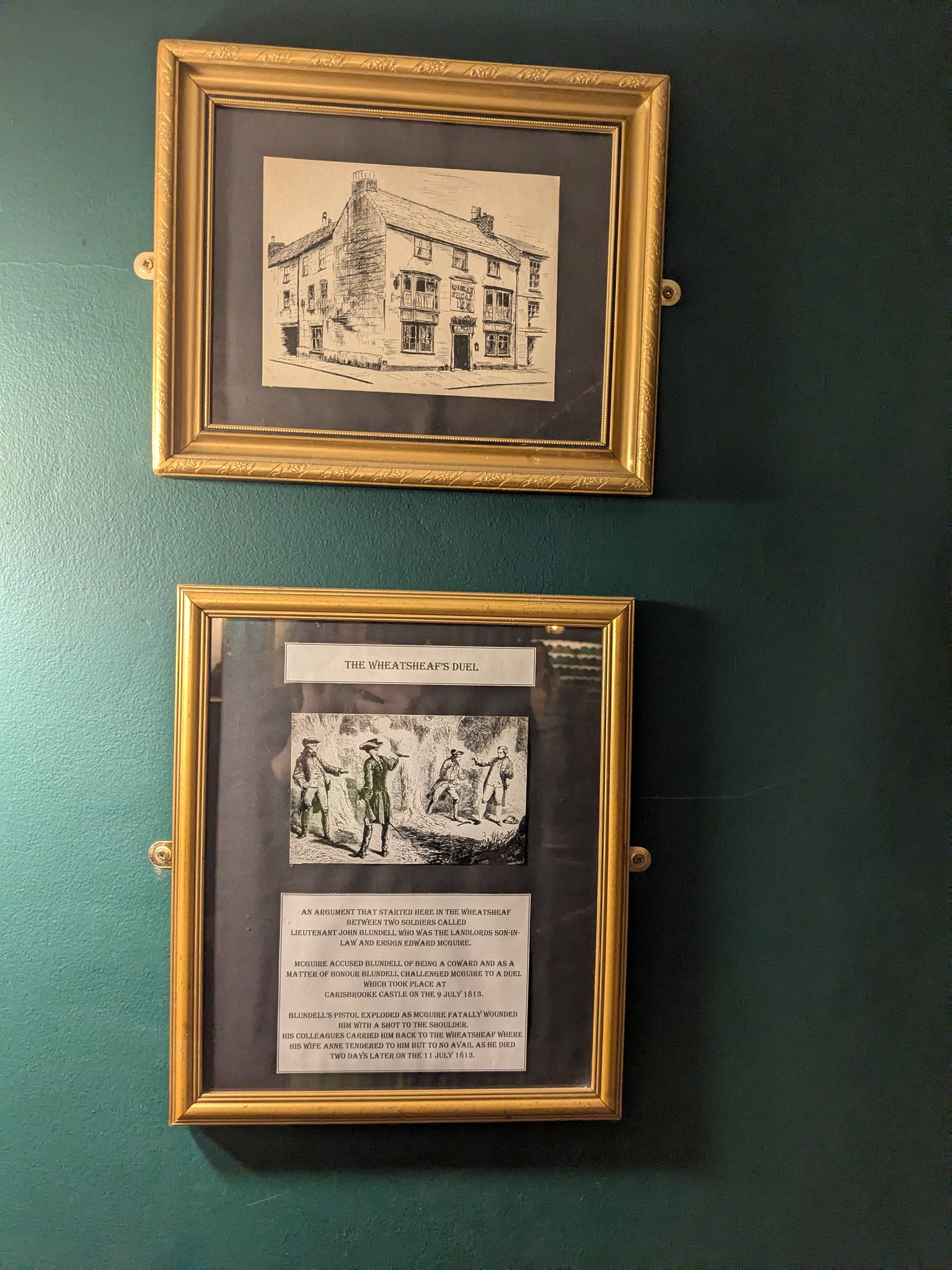
Which is to say….
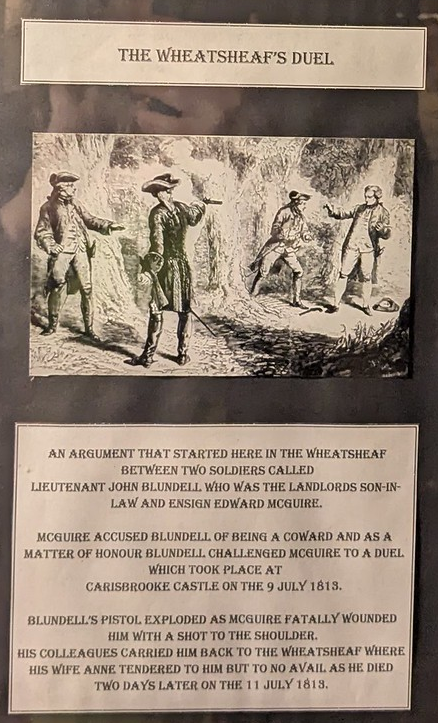
The Wheatsheaf Duel
An argument that started here in the Wheatsheaf between two soldiers called Lieutenant John Blundell who was the landlord’s son-in- law and ensign Edward Mcguire.
Mcguire accused Blundell of being a coward and as a matter of honour Blundell challenged Mcguire to a duel which took place at Carisbrooke Castle on the 9 July 1813.
Blundell’s pistol exploded as Mcguire fatally wounded him with a shot to the shoulder. His colleagues carried him back to the Wheatsheaf where his wife Anne tendered to him but to no avail as he died two day’s later on the 11 July 1813.
Here’s my firzt attempt at retelling this tale as a historical tale.
The Wheatsheaf Duel
If you happen to scan your eyes over the wall opposite the bar in the Wheatsheaf Hotel in Newport, on the Isle of Wight, you might notice a framed print that relates the tale of an argument that started in that very place in July 1813. The argument was between two soldiers — Lieutenant John Blundell, the Landlord’s son-in-law, and the lower ranked ensign Edward McGuire. He’d apparently accused Blundell of being a coward, a charge against a man;s honour that could not be ignored, and which led to a duel at Carisbrooke Castle. Blundell’s pistol exploded and he was fatally wounded with a shot to shoulder. He was brought back to the Wheatsheaf where his wife Anne tended to him, but to no avail, and he died a couple of days later.
Such is the tale that hangs on the on the wall. But whenever I see such things, I always like to check. Now if you’re into duels, there’s a two volume work from the 1840s called “The History of Duelling” — you can find in the Internet Archive, archive.org, which has thousands of scans of books going back to whenever — which records duels throughout the ages, or at least, up to 1841; but the reference there is even briefer than the description on the wall here. It does give a time for the duel — 2.30 in the afternoon — although the newspaper reports at the time suggest the duel took place early in the morning.
So what actually happened? A subscription to the British Newspaper Archive is one of the best presents I’ve ever bought myself, so here’s the tale based on what I can remember, or perhaps, misremember, from what I found in the papers of the time, the sort of thing that might have been talked about in the pub, then passed, as the “folk truth” of what happened. Because remember, stories are what’s left when the facts are forgotten.
The Wheatsheaf was quite an important pub in the town at the time (this is 1813, remember). Auctions were held there via the local auctioneers — Pittis’s — and the inn was a departure point for carriage and boat transits over to Portsmouth operated by a character who also had a pub in Ryde that was the departure point of the Royal Mail coach back to Newport, presumably after receiving the mail from Portsmouth via the passage operated by him. The pickup point in Portsmouth, the Quebec Tavern, has a role to play in another duelling tale — the last duel in Britain in which an Englishman died, which took place in the 1840s in Gosport, but that’s another story, a Solent Tale, for another day.
A couple of months before, Lieutenant Blundell, the son of a London merchant, was married, in Newport, to a recent widow, Mrs. Ann Monro, daughter of a notable chap from Portsmouth, Henry White, who would soon become Mayor there. She had previously married another soldier, Captain Monro, just eighteen months before, but he had died in active service just three or four months after their wedding.
A few weeks after his wedding to Mrs Monro, it appears that Lieut. Blundell took a young officer of his corps, to a cottage in Niton, to dine with him. Another soldier, Ensign M’Guire, an Irishman, who was stationed with Lieut. Blundell, seemed to take offence at this appearance of favouritism. (M’Guire may or may not have been the person who gave Blundell’s wife, Ann Monro, away. Various names are confused in the original reports.) Blundell made light of M’Guire’s comments, which wound M’Guire up so much that he wrote to the officers of the Blundell’s Regiment, calling him a rascal and a ruffian. The officers took this up with Blundell, and said that in their opinion, in return for this slight on his honor, he must fight M’Guire (who was from another regiment). Blundell thought this was a bit extreme, and seems to have tried to make arrangements to go up to London as a face saving way of getting out of a fight, but, at last, he had to relent and made a written challenge to M’Guire.
Presumably aware of the impending fight, Blundell’s wife Ann was distraught. She’d already lost one husband and didn’t want to lose another. So on Thursday, 8th of July, about eight in the evening, the Rev. Jon Barwis, a Magistrate living in Niton, (perhaps where Blundell had gone to dine?) was informed by Mrs. White, Ann’s mother, Blundell’s mother-in-law, that Blundell wished to see him; he went to her about dusk, then went to the White Lion (which was at Coppins Bridge, just near where the Church on the roundabout is now), and asked the landlord for Mr. McGuire, who was aged 28. They paced backwards and forwards outside the inn for a while, in conversation with each other. Based on information he’d received, the reverend wanted M’Guire to keep the peace. McGuire replied that he was a peaceable man, but he’d been ill used: Blundell had raised a report that he had supplied McGuire with clothes, and he’d been dishonoured too. Now, at that time, duelling had a strange relationship with the law. There was still a right to issue a trial by battle in the law courts (and there’s a story for another day about the last time such a challenge was issued a few years later), but in the case of duelling, if there was a fatality, then it was murder, and everyone involved in the duel, principals and seconds alike, was guilty. The magistrate warned M’Guire again, and asked him to give his word and honour that he would go back to the barracks and not fight Blundell; McGuire said he would go back to the barracks, and he wouldn’t challenge Blundell. The Reverend went back in to the White Lion and sent a message for Blundell to come and see him: he waited a considerable time, and: nothing. So went to where Blundell was staying, perhaps to the Red Lion, just round the corner from the Wheatsheaf, where he saw Blundell eating and drinking along with a couple of others, Lieut. Dillon, aged 26, and another Irishman, O’Brien, aged 17. He chatted privately to Blundell for a few minutes, then spoke to the others, saying he feared they were up to no good, and that he was a magistrate, and that he came to keep the peace; if they were planning a duel, he would bind them over. Blundell then said, that in certain situations, gentlemen in the army were obliged to fight duels; and Dillon replied that if any officer in his regiment refused to fight, he should feel it his duty to inform the commanding officer. The others agreed. The reverend repeated that he’s have no fighting, and asked if there was any alternative? But Dillon said some situations demanded a fight. “There must be no fighting.” To which he got the reply: “there will be no fighting in your district”. The officers returned to their food and drink and the reverend left them to it.
The following morning, a servant to Gilchrist who was stationed in Parkhurst Barracks, was ordered to take a case to Newport a case, although he didn’t know what was in it. From there, he went with Gilchrist, to Carisbrook Castle. They were joined shortly after by M’Guire, Gilchrist having the dubious honour of being M’Guire’s second. Blundell and a Mr. Heming also turned up; they then proceeded round to the back of the Castle, where Heming (Blundell’s second) measured out 12 or 13 paces. Blundell’s second asked Gilchrist, M’Guire’s second, for a pistol, who replied, “if you have it, it shall be without my consent; it’s not my wish they should be used today.” Blundell then asked his second to get one of his own guns, and the pistol was produced and loaded. The seconds stepped back about 15 or 20 yards, and Blundell’s second gave the word, “make ready, present, fire,”—or, “make ready, fire.” Blundell and M’Guire both fired together. Blundell stood his ground, and handed his pistol to Heming, his second, who said it was burst. Blundell asked Gilchrist if he could borrow another, as he wished to have another shot. Both seconds spoke with Blundell, and then with M’Guire, and both M’Guire’s pistols were reloaded. M’Guire and Blundell each took one, and Blundell’s second gave the word again. This time when they fired, Blundell fell. The other three came up to him and Blundell said—“My dear M’Guire, I am dying, but I forgive you from my heart and soul.” Gilchrist shook hands with him, and said—“Are you satisfied that we have behaved as Gentlemen to-day?” and he replied, “Yes, my dear Gilchrist, I die in peace with you all.” Gilchrist’s servant was then sent to get a Doctor; when he returned, the others had gone.
Blundell was brought in blanket from Carisbrooke Castle, back here, to the Wheat Sheaf Inn, where his wife would tend to him. The ball had entered sideways into the right shoulder, crossed his back, taking a part of the vertebrae, broken a rib, and lodged near the arm-pit. An Adjutant from the Army Depot was sent to inquire into the circumstances, getting there late afternoon, and asked who the seconds were. Blundell told him. saying he was mortally wounded, and that he and M‘Guire had had an altercation, that it hadn’t been his wish to fight if he could help it, he didn’t owe M’Guire any animosity, but he had been compelled to do it by O’Brien and Dillon.
Blundell’s father-in-law, Henry White, also spoke with him the next day, the Saturday, when Blundell said he had received a wound, which he supposed to be mortal; it wasn’t his fault, it was a malicious business, that he couldn’t help it, that he never wanted to fight, and that O’Brien and Dillon had compelled him to do it.
Blundell died later that day, or maybe the next.
On Monday and Tuesday an Inquest was held; the Jury returned a verdict of Wilful Murder against Ensign Maguire, as a principal in the first degree; and Gilchrist and Hemming, as principals in the second degree; a couple of others were also mentioned as accessories before the fact.
The case was passed up to the Summer Assizes at Winchester. All the charged parties, except for Heming, Blundell’s second, offered themselves up for trial at the Assizes.
All four were convicted of murder, and despite receiving good characters, the mandated sentence of death was passed on them; this was then respited till later that month, and then again till the next month. The affair had caused so much interest and anxiety throughout the army, that the Commander in Chief had made a special military case to the Prince Regent for clemency. Following a full consideration of all the circumstances, the three soldiers were pardoned. The two duellists had been deemed the least guilty; Dillon was declared incapable of serving his Majesty again, for not having used the influence of his superior rank over inexperienced minds, for conciliating rather than inflaming the parties involved. The other two, O’Brien and Gilchrist, were dismissed from the army although they would be able to return.
Another year on, June 1814, and Mrs. Blundell, previously, Mrs. Monro, née White, was to marry again. (It was a big time for the family. Her father, who was coming to the end of his year’s term as Mayor of Portsmouth, was also knighted by the Prince Regent a month later.) How long Ann White’s third marriage lasted, I can’t say — maybe there’s another story there? — but the story still isn’t quite finished.
Let’s skip forward, to 1817.
A transportation ship, the Larkins, arrives at Portsmouth on her way to Botany Bay. The Mate of the Captivity, one of the convict service ships used to put convicts under sentence of transportation on board the Larkins, had heard a rumour that on board the vessel, one of the convicts was actually Gilchrist, the man who had been engaged in a duel a few years before, and who had had been found guilty of murder. Back in the dock yard, whilst chatting to one of the proprietors of the Hampshire Telegraph, he repeated the rumour just as he heard it. Even though the Larkins hadn’t yet sailed, the newspaperman didn’t go on board to check — what would the point be? — but accepted the information at face value and ran the story soon after, by which time the Larkins had set sail.
The story mentioned that among the convicts being transported to New South Wales by the Larkins, was Gilchrist, previously tried and convicted at Winchester Assizes for the foul murder of Lieut. Blundell, in a duel at Newport,and who had afterwards received a transmuted sentence. He had lived a life of great moral turpitude and was in the process of being banished from Britain for the crime of forgery.
The story was widely copied in the morning papers around the country, including the London papers, over the next few days. But it wasn’t actually true, because Gilchrist was living his best life in London and very much not being transported for forgery or anything other crime. Gilchrist was not happy, as you might expect. A friend of the proprietor of The Military Register took Gilchrist to see him, at which point Gilchrist, who was almost in a state of madness from the agitation of his wounded feelings, showed the publisher the article, as well as a letter from the judge in the original murder trial stating that Gilchrist had unavoidably been involved as a second in a duel, which had been a fair duel, and he had never been charged, let alone convicted, of any other offence, let alone “forgery”. There had never been any ‘transmuted sentence’ — he’d received an absolute pardon — so what he could do about such a libel? The publisher of The Military Register then assured him that the owners of the Hampshire Telegraph would do the right thing by admitting to their mistake and making good, then immediately republished the defamatory statement, along with a list of rebuttals and a statement that Gilchrist was in his office with him right now.
And then, silence. Nothing, for five weeks or so. The Military Register article appeared to go unnoticed.
The result was that Gilchrist then took the proprietors of the Hampshire Telegraph to court asking for 3000l. in damages (about £150,000 today). As with such cases today, the case generated considerable interest, and when proceedings began, the Court was crowded at early doors by an expectant audience.
Gilchrist’s counsel made a simple case: the libel had been published, and widely syndicated, to the detriment of Gilchrist’s character, and the defence knew what had been published was untrue. He didn’t care whether the motive for publishing the article was from malice or neglect, but no man was to go forth armed with a loaded blunderbuss, either wilfully or carelessly discharging the contents against the innocent and inoffensive. His client was an honourable man, of high character, so what in the name of God could be the motive for making such a foul and atrocious a libel? Yes there’d been a duel, and yes a man had died, and yes, people were charged, but Gilchrist was unavoidably dragged into it and was no “foul murderer” — even the original judge from the original trial said he’d behaved honourably — and he’d afterwards received a full pardon. As to him being on board a transportation ship — pure nonsense. They could at least have shouted over to the ship — it still hadn’t sailed — to check the story, but that was too much effort for them, they just ran with the rumour. And a forger? Where were the reports of that case? If it was in the public interest to publish that the Gilchrist was being transported, wouldn’t it also have been in the papers that he was on trial for forgery? He believed in a free press, of course he did, of course it was important to hold public figures and public measures, to account, but that didn’t mean they should line their pockets by selling scandal, rumour, libel and lies, particularly when applied to private individuals. The Press was indeed one of the greatest blessings ever known, if rightly exercised; but if it deviated from public praise or public censure, and descended into slander or malignant attack upon private character, simply for sordid monetary gain, then it became a curse and not a blessing. Even though the proprietors of the Hampshire Telegraph knew from the Military Review within a couple of days of the story being published, that it was lies, it took them another five weeks before they published their retraction. (Not surprisingly, the defence objected that what the other papers had done was nothing to do with them.) The “evidence” of Gilchrist being on board the Larkins was a just a second hand rumour, which had then been published as a fact. No editor should let his arrows fly so loosely, due caution was necessary by the public press in matters relating to private individuals, and no apology could repair the damage to reputation it could cause.
After the libel was read out, the defence counsel said he had the painful duty of fully admitting the article was without foundation, and that as there was no defence they could make, all the defence counsel could do was offer mitigation against the size of the damages claimed. Two convicts who had been sentenced to transportation at Horsham for forgery gave feigned names when they were on board, and for some reason — who knows why — Gilchrist’s was one of them, and this was implicitly believed on board the convict ships. The publishing of the libel was an involuntary error, and the defendants should be tried on what they did next. They had been proprietors of the Hampshire Telegraph for many years, and this was the first time they’d ever been called in such a case. For a considerable time after the paragraph was published, they’d had no reason to doubt its truth; but eventually, a friend called and showed them a paragraph in The Military. Register, stating there was no foundation whatever for the claims made against Mr. Gilchrist, who was at that time was apparently sat at the very elbow of the writer. They tried to write to Gilchrist as soon as they heard this news, but as they didn’t know his address, they sent their letter to the proprietor of The Military Register, who obviously had been in contact with him, offering to make an apology, and publish any retraction or statement he cared to dictate. But they didn’t get any answer. So a few days later they wrote again, repeating the offer, and then heard, for the first time, that Gilchrist thought an apology should have been published soon after the time they’d libelled him and he wouldn’t accept one now. So what could the proprietor of the Hampshire Telegraph do? (What they actually had done was publish a retraction after a London newspaper that had run the original story had picked up on the Military Register a month or so after it had been published and run their own retraction.) Admittedly, a paragraph had gone afloat stating that he was a convict on a voyage to Botany Bay, but would his friends believed that, when they could see him at the very same time moving around London in honourable society? And it was extraordinary that he’d taken so long to seek redress. As it was, they accepted damages should be paid, but it should also be remembered they weren’t a London paper, but just a little provincial newspaper with limited circulation and limited means. If the trial had been held in Hampshire rather than London, they would have benefited from a Jury more likely to know of the previous prudence and high character of the Hampshire Telegraph, and surely the current jury would be mindful of that. A monetary payout surely offered no real sense of compensation to the wounded feelings of a British Officer, but if nothing but money, would do, then the Jury would estimate the amount according to the situation of the defendants, and the sense they had shown in seeking to redress the mistake they’d unwittingly made.
It didn’t take long for the Jury to come to their decision. After a short consultation, they returned a verdict for Gilchrist and awarded 500 pounds in damages (about £25,000 today).
And there the tale does come to an end.
Checking volume II of J. G. Millingen’s The history of duelling, published in 1841, which itemises duels in Great Britain and Ireland up to 1841, we find the following scant description of the event.
A Duel Was Fought, July 1813 (1841)
In J. G. Millingen, The history of duelling, volume II, 1841, p209.
BETWEEN LIEUT. BLUNDELL AND MR. MAGUIRE. July 12, 1813.
A duel was fought yesterday at Carisbrook Castle, Isle of Wight, at half-past two o’clock, P.M. agreeably to the written challenge of Lieut. Blundell, between that gentleman and Mr. Maguire, when at the second discharge of pistols, Mr. B—— received a mortal wound, of which he died two days after.
Needless to say, my next stop was the British Newspaper Archive to see what the local newspapers of the time had to say about the affair.
Introducing the Wheatsheaf#
The Wheatsheaf Hotel is one of the few surviving pubs of old Newport. It must have been a sizeable inn even in the early 1800s, acting as a location for local auctions, amongst other things.
Old-established Public-House, December 1826
In Hampshire Chronicle, Monday 18 December 1826.
TO BREWERS, INN KEEPERS, AND OTHERS.
Capital Free and Old-established Public-House, in one of the best situations in the town of Newport.
TO SOLD by AUCTION, by Mr FRANCIS PITTIS, by order and under the direction of the Executors of the late Mr. F. Kiddle, on Tuesday the 19th of December, 1826, at the Wheat-sheaf Inn, Newport, Isle of Wight, all that Good Accustomed PUBLIC HOUSE, known by the name of the Red Lion, situated in the centre of St. James’s Square, where the cattle market is held, and now in the occupation of Mr George Pedder. The house is very substantially brick built, and comprises on the ground floor, three sitting rooms in front, two back ditto, a good cellar, large stables, and stores; the second floor, two large rooms in front, and three back bed rooms the attic, six sleeping rooms. The whole of the rooms are well arranged, and the premises are front thirty-seven feet.
The Sale to commence precisely at Six o’Clock in the Evening.
A town plan from the mid-19th century shows the preponderance of pubs around St Thomas’ square and the site (at the time) of the new Church there, built in the early 1850s on the site of the previous one.
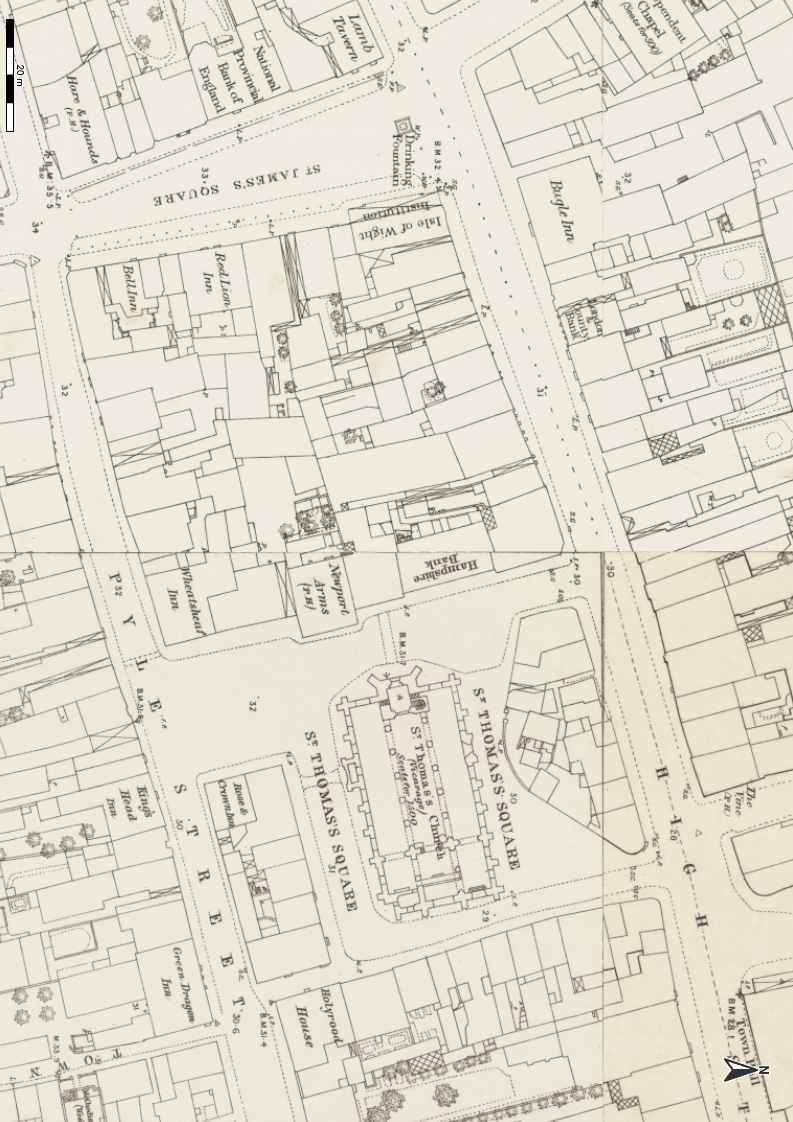
The Wheatsheaf also appears to have been a departure point for transits over to Portsmouth, via passage provided by Mr James Beazley. His new pub in Ryde in 1811, (the Bugle), also seems to have been the departure point of the Royal Mail coach to Newport, presumably after receiving the mail from Portsmouth via the passage operated by Beazley.
Newport to Portsmouth, 1811
In Hampshire Telegraph, Monday 22 July 1811.
BUGLE INN, RYDE,—ISLE OF WIGHT. JAMES BEAZLEY, Sen. begs leave to inform his Friends and the Public in general, that he has succeeded Mr. Robert Williams at the above Inn, which (although in an unfinished state at present) he has opened; and trusts, by his long experience in conducting the Passage to and from the Island, his assiduity, and attention, to accommodate those who may be pleased to honour him with their company, so as to merit a continuance of their favours.
Tbe Passage to and from the Isle of Wight, will be continued by him as usual, from the West India and Quebec Tavern; and a Telegraph Coach will wait its return daily from Portsmouth, to the Wheat Sheaf at Newport.
J. B. has laid in a good assortment of choice old Wines and Liquors of the first quality.
N.B. The Mail is conveyed every morning from the West India and Quebec Tavern, Portsmouth, by Messrs. Moore and Beck, to the above Inn, where the Royal Mail coach waits its arrival to proceed to Newport.
Post Chaise and Horses on the shortest notice.
The Quebec Hotel in Portsmouth features in the tale of another Solent duel, in 1845, but that is another story for another day…
A Duel Near Carisbrooke#
The first news of the duel, which took place on Friday, July 9th, 1813, started to appear a couple of days after the event. In the initial reports, the duel had not proved immediately fatal.
A Duel Near Carisbrooke, July 1813
In Statesman (London), Monday 12 July 1813.
Duel.—We are concerned to hear that a duel took place on Friday, near Carisbrooke, in the Isle of Wight, between Lieutenant Blundell, and Lieutenant M’Gregor, of the 101st Regiment, in which the former received a wound, which is considered likely to prove fatal to him. Lieut. B was lately married to the daughter of H. White, Esq. of Portsmouth; and what is remarkable, his adversary in this unfortunate dispute gave the Lady away.
Lieutenant Blundell was just recently married, in Newport, to a widow, Mrs. Monro, although no mention is made of M’Gregor having given the bride away.
Married, June 1813
In Stamford Mercury, Friday 25 June 1813.
MARRIED. On the 16th instant, at Newport, (Isle of Wight,) John Blundell, Esq. of the 101st regiment of foot, Mrs. Monro, relict of the late Captain Monro, of the 42d regiment, and daughter of Henry White, Esq. of Portsmouth.
Mrs. Monro’s previous husband had also been an officer in the British Army, killed in the line of duty a year before. So perhaps M’Gregor was a family friend, or had served with Captain Monro?
Previously widowed, May 1812
In Caledonian Mercury, Thursday 07 May 1812.
Private accounts from the army in Spain, state the death of Captain Monro, of the 42d regiment, at the siege of Badajoz, though his name does not appear in the Extraordinary Gazette. He was the second officer who attempted to scale the walls, and was shot through the body, when at the top of the ladder. It is only a few weeks since he resigned his situation as Aid-de-Camp to General Whetham and embarked from Portsmouth to join his regiment. He lately married a daughter of Mr H. White, of that town. He had seen much service before, in Spain and Portugal, and was esteemed a good soldier.
It seems that Mrs. (Ann) Monro’s first marriage had also been short lived.
Married, January 1812
In Sun (London), Friday 31 January 1812.
Marriages
A few days since, at St. Paul’s, Covent-garden, Captain G. A. Monro, Aid de-Camp to General Whettam, of Portsmouth, to Anne, daughter of Henry White, Esq. of that place.
Regarding the duel, Drakard’s Stamford News commented wryly on the affair.
Pride in Duelling, July 1813
In Drakard’s Stamford News, Friday 16 July 1813.
A duel took place near Carisbrooke, in the Isle of Wight, between Lieut. Blundell and Lieut. M’Gregor, of the 101st regiment, in which the former was severely wounded. Lieut. B. was lately married to the daughter of H. White, Esq. of Portsmouth; and what is remarkable, his adversary in this unfortunate dispute gave the lady away.
To shew with what justice we are proud of duelling, we translate a passage from Voltaire, des Turks, v. 6 p. 243. “The Turks are brave, but duelling is unknown to them: this is a virtue common to them with all the Asiatics, and it arises from the custom of never going armed, except in war. Such was also the usage of the Greeks and Romans; and opposite manners did not introduce themselves amongst Christians, until the days of barbarism and chivalry, when it was counted a duty and an honour to walk about with spurs at their heels, and to sit down at table, or to offer up prayers to God, with a long sword by their side. —The christian nobility distinguished themselves by this custom, soon followed by the common people, and at length ranked amongst those absurdities, the folly and wickedness of which are not perceived, because they are of every day’s occurrence.”
Although the Hampshire Telegraph — or to give it its full name, the Hampshire Telegraph and Sussex Chronicle; or, Portsmouth and Chichester Advertiser — did not pick up on the news of the duel that week, it did manage to report on another incident involving a military man:
A Dreadful Cliff Accident, July 1812
In Hampshire Telegraph, Monday 20 July 1812, no. 667, vol. XII.
On Wednesday last a private of the 63d Regt. of the name of Webster, in attempting to descend a short distance down the awful and tremendous cliffs at High Down, in the Isle of Wight, about 200 yards east of the Signal House, lost his hold, and was precipitated to the bottom, a distance, it is supposed, of about 630 feet. A boat containing some gentlemen, who were making a tour of the island, and were going by water from Allum Bay, through the Needles, to Freshwater Gate, happened luckily to pass within a few minutes of the fall, and immediately carried the mangled body of the poor sufferer, placed him in the boat, and took him to Freshwater Gate, and who, wonderful to relate, was still alive and spoke. Surgical assistance was procured without delay, and the supposition is that the wretched man may recover! Amputation of the right arm, which was most dreadfully broken, was about to be performed, when the gentlemen left Freshwater Gate, and the sight which the miserable being exhibited, from his head and other parts of him being most horribly cut and bruised, formed an object which was sensibly felt by the persons lending him assistance, and must have filled the strongest mind with horror.
News was often slow to travel, and relative times of “seven days ago” (se’nnight) in newspaper reports could often end up meaning a date between seven and fourteen days previously, depending on the date on which the report was written, or typeset, and not necessarily from the date it was published. So from the following report which appeared a couple of weeks after the event, we might infer that Lieutenant Blundell, wounded in the duel, had succumbed to his injuries and died a couple of days after the event, on Sunday, July 18th, 1813.
Lieutenant Blundell died the Sunday following, July 1813
In Cambridge Chronicle and Journal, Friday 23 July 1813.
FATAL DUEL.— The duel which look place Friday se’nnight, near Newport, Isle of Wight, between Lieutenant Blundell, 101st regiment, and Lieut. Maguire (not M’Gregor,) of the 6th West-India regiment, has terminated fatally. Lieutenant Blundell died the Sunday following. The ball entered the right shoulder, in an oblique direction, crossed the back, taking part of the vertebrae, and lodged near the arm-pit; mortification, delirium, and death, were the consequences. The deceased was the son of J. Blundell, Esq. merchant in London.—A Coroner’s Jury has been held on the body, and a verdict of Wilful Murder returned against Lieutenant M’Guire, and several other persons who were present, the whole of whom have absconded.
A report in the Morning Chronicle a couple of days before the Cambridge Chronicle report was a little more forthcoming in naming the several parties identified as being responsible for the “Wilful Murder” of Lieutenant Blundell. That those involved had absconded was also noted.
The Coroner’s Jury’s Verdict, July 1813
In Morning Chronicle, Tuesday 20 July 1813.
Fatal Duel.— The duel which took place on Friday se’nnight near Newport, between Lieut. Blundell of the 101st regiment, and Lieut. M’Guire (not M’Gregor) of the 6th West-India regt. has terminated fatally. Lieut. Blundell died on Sunday noon last. The ball entered the right shoulder, in an oblique direction, crossed the back, taking part of the vertebrae, and lodged near the arm-pit; mortification, delirium, and death, were the consequences. The deceased was the son of J. Blundell, Esq. merchant in London.
On Monday and Tuesday an Inquest was taken on the case by Thomas Sewel, Esq. the Coroner for the Island, and a most respectable jury; after a full and minute investigation of the circumstances, and an impartial summing up of the evidence by the Coroner, the Jury returned a verdict of Wilful Murder against Ensign Maguire, as a principal in the first degree; against Ensign Gilchrist, of the 6th West India regiment, and Lieut. Hemmings, of the 101st regiment (the seconds), as principals in the second degree; and against Lieutenant Kinsley and Ensign Slater, of the 101st regiment, as accessories before the fact.
The principals and seconds absconded immediately after the duel.
The case was passed up to the Summer Assizes at Winchester, which ran from Tuesday, July 27th, to Saturday, July 31st, 1813. All the charged parties, except for Heming, Lieutenant Blundell’s second, offered themselves up for trial.
Surrendered Themselves, August 1813
In Taunton Courier and Western Advertiser, Thursday 12 August 1813.
ASSIZE INTELLIGENCE. At Winchester Assizes
…
The last trial at the Hampshire assizes was that of the young men who were concerned in the duel at Carisbrook, in the Isle of Wight, and which took place on the 9th ult. between Lieut. Blundell and Ensign M’Guire, the former of whom was killed.—M’Guire, with his second, J. Gilchrist, and A. Dillon and D. O’Brien, who were deemed accessories, surrendered themselves on Friday. They were all four convicted of murder, and sentence of death was passed on them, but they were respited till the 21st inst.
Or maybe the trial took place on the first day of the Assizes, Tuesday, July 27th, 1813, which would suggest the men had turned themselves in on the Friday before the Assizes started, July 23rd, 1813.
“On Tuesday”, August 1813
In Pilot (London), Tuesday 03 August 1813.
Winchester Assizes.
…
At the same Assizes, on Tuesday, Edward Macguire [sic], Andrew Dillon, Joseph Gilchrist, and Daniel O’Brien, charged with the wilful murder of Lieut. Blundell, in a duel at Carisbrook, in the Isle of Wight, on the 9th ult. were all found guilty, and received sentence of death. They are, however, respited till the 21st of this month.
A few more details of what had prompted the duel appeared in the Hampshire Chronicle report of events at those sessions.
Four Men Charged in Connection with Blundell’s Death, August 1813
In Hampshire Chronicle, Monday 02 August 1813.
WINCHESTER, Saturday, July 31. HAMPSHIRE ASSIZES.
On Tuesday last the Commission for holding the Assizes for this country was opened before the Hon. Sir Robert Graham, and the Hon. Sir Vicary Gibbs, Knts.
…
There were forty prisoners on the calendar for trial, the following 13 of whom were capitally convicted, and received sentence of death:—
…
Edward M’Guire, aged 28, and James Gilchrist, for the murder of John Blundell, in a duel, at Carisbrook, in the Isle of Wight.
Anthony Dillon, aged 26, and David O’Brien, aged 17, for having incited, counselled, and instigated Edward M’Guire to murder the said John Blundell. The particulars of this unfortunate catastrophe are follows:—
Lieut. Blundell took a young officer of his corps, to a cottage in Niton, to dine with him. Ensign M’Guire, belonging the West India Regiment, who was stationed with Lieut. Blundell, took offence at this circumstance, perhaps thinking it a partiality which reflected on him. Lieut. Blundell treating the observations made by M’Guire, on this occasion, with disregard, the latter became so enraged, that he wrote to the officers of the 101st Regiment, to which the deceased belonged, calling him a rascal and a ruffian. On the receipt of this letter, the officers waited on Lieut. Blundell, stated the calumny uttered against him, and gave it as their opinion that he must fight him. Lieut. Blundell for some time evaded coming to this crisis, but, at last, he gave these gentlemen a challenge for Ensign M’Guire, and the parties met near Carisbrook, very early the next morning, without having taken repose. Lieut. Blundell’s first pistol burst; his second handed him another, but never proposed a reconciliation. Another shot was fired, Lieut. Blundell fell; he was taken in blanket to the Wheat Sheaf Inn, Newport, where died. The ball, it seems, entered sideways into the right shoulder, crossed the back, taking a part of the vertebrae, and broke a rib. He died the day after the wound was received. Two servants, one belonging to each of the duellists, were on the spot during the whole time.
…
Of the capital convicts, Edward M’Guire, James Gilchrist, Anthony Dillon, and David O’Brien are respited till August 21.
M’Guire had been the other party in the duel, with Gilchrist as his second. Heming had been second to the deceased, Blundell.
A more comprehensive report of the trial appeared in the Morning Chronicle. The implication was that Gilchrist, M’Guire’s second, had been reluctant on the day of the duel that it should take place, and that Blundell had also sought to avoid the duel by going up to London. But several other members of the soldiery had forced him into the encounter.
Principals and Accessories in the Late Fatal Duel, August 1813
In Star (London), Tuesday 03 August 1813, also Morning Chronicle, Wednesday 04 August 1813.
Assizes, Winchester, July 31.
These Assizes terminated this day. The following were among the cases tried:
…
Ensign M’Guire, Ensign Gilchrist, Lieutenant Dillon, and Lieutenant Daniel O’Brien, the principals and accessaries in the late fatal duel at Newport, were tried for the murder of Lieutenant Blundell, of the 100th regiment. (Lieutenant Heming did not surrender himself). The principal circumstances in this case, besides those already given in this Paper, were comprised in the following evidence:
James Fitzgerald, a private in the 69th regiment, stated, that he was a servant to Ensign Gilchrist, that he was so on the 9th of the month, and stationed in Parkhurst Barracks; that by order of his master he took to Newport a case, but did not know its contents; afterwards went with his master to where the duel was fought, at the back of Carisbrook Castle. Mr. M’Guire was with his master soon after they were there. Mr. Blundell and Mr. Heming came to the spot; they then proceeded to the back of Carisbrook Castle, and Mr. Heming measured out the ground, taking either 12 or 13 paces. Mr. Heming asked Gilchrist for a pistol: Gilchrist answered, if you have it, it shall be without my consent, and it was against his wish that they should be used on that day. On this Mr. Heming was desired by Mr. Blundell to get one of his own, and the pistol was produced and loaded. Witness retired about 15 or 20 yards, and Mr. Heming gave the word, either “make ready, present, fire,”—or, “make ready, fire;” and they both fired together. Blundell stood his ground, and handed his pistol to Heming, who said it was burst, and Blundell asked to borrow another of Gilchrist, as he wished to have another shot. Then Gilchrist and Heming went to Blundell, and afterwards to M’Guire, but he did not hear what had passed. After this they loaded M’Guire’s pistols, and each took one, and then Mr. Heming gave the word again, and they fired, and Mr. Blundell fell. Then M’Guire, Heming, and Gilchrist, came up to him; Blundell said—“My dear M’Guire, I am dying, but I forgive you from my heart and soul.” Then Gilchrist shook hands with him, and said—“Are you satisfied that we have behaved as Gentlemen to-day?”— He replied, “Yes, my dear Gilchrist, I die in peace with you all.” Witness was sent for a Doctor, who he met coming out, and when he returned the parties were all gone.
Thomas Rayles, Captain and Adjutant at the Army Depot, in the Isle of Wight, on the 9th was in company with the deceased J. Blundell. In consequence of a letter, witness waited on the deceased, who told him he was mortally wounded. Witness told him he was sent by General Taylor to inquire into the circumstances, and requested him to inform him who were the seconds: he replied Heming was his second, Gilchrist the other’s. He said that M‘Guire and he had an altercation, but that it was not his wish to meet M’Guire if he could have helped it, but that he was in a manner compelled to it. On asking him in what way he was compelled, he said several Officers had been to him; among them were O’Brien and Dillon; that he did not owe M’Guire any animosity. It was between four and five in the afternoon when he went down to Blundell. He understood on the same day the duel took place, there were several person’s in the room when he went there, but did not particularly observe any one; he went to Blundell, for the purpose of collecting the particulars: he told him it was not his intention to have fought if he could have avoided it; that he had the Adjutant-General’s permission to go to London; that he intended to let the business pass over, and to have got on the half-pay, and that he was going off on that day; O’Brien and Dillon told him if he did not meet M’Guire, he should be discarded.— Witness did not hear from the deceased how the dispute originated.
Henry White is father-in-law to the deceased; saw him on the 10th instant, and was told by him that he had received a wound, which he supposed to be mortal: said he was sorry to see him in such a situation; that it was not his fault; it was a malicious business—that he could not help it—and that he did not wish to fight—that O’Brien, Dillon and others, had come down to the White Lion, the evening before, and he was obliged to do it by the Officers he had been conversing with.
Mr. Dillon said, in his defence, he was not aware of being implicated in this charge, till yesterday morning; from the shortness of the notice, he could not procure his witnesses.
Mr. M’Guire said he was a native of Ireland, and a stranger in this country—that he was challenged by the deceased, and as a Gentleman was obliged to accept it.
Mr. Gilchrist said, he was a native of Scotland; from the shortness of the time since the transaction he had not sufficient time to obtain witnesses to his character.
Mr. O’Brien was a native of Ireland, and there was not time to acquaint his connections with his situation.
The prisoners severally received good characters from some of their brother officers, who were well acquainted with them at the depot.
The four prisoners were all sentenced to suffer Death on Monday next, but were afterwards reprieved until the 21st of August.
The Norfolk Chronicle made no bones about who they thought might have provoked the duel.
Bloodthirsty Young Irish Officers, August 1813
In Norfolk Chronicle, Saturday 07 August 1813.
At the Hampshire Assizes, Edward M’Guire, Andrew Dillon, Joseph Gilchrist, & Daniel O’Brien, charged with the wilful murder of Lieut. Blundell, in a duel, in the Isle Wight, were all cast for death, are respited to the 21st of August.— Blundell was proved to have said there was malice [sic] in the business;— some bloodthirsty young Irish Officers threatened to discard Blundell if he did not fight M’Guire, though scarce any difference subsisted between them.
A report that appeared in several locations, including the Saint James’s Chronicle and the London Courier and Evening Gazette, repeated verbatim much of the text that also appeared in the Star (London) report, but also included further detail about what had happened on the evening of Thursday, July 8th, 1813, the night before the duel, as well as the character witness testimony, or lack of it.
In particular, Blundell’s mother-in-law appears to have got wind of trouble between Blundell and M’Guire, and called on a magistrate, Rev. Jon Barwis of Niton, to intercede. He finds M’Guire at the White Lion, at the corner of Barton Road and Coppins Bridge, next to where the Church on the roundabout is today, and gets him to agree that he will not issue a challenge to Blundell. He then summons Blundell, but on Blundell not turning up, Barwis seeks him out, where Blundell is in the company of Dillon and O’Brien. Blundell appears to have claimed that in some situations a duel was necessary, and Dillon implied that it might also be expected. On trying to deter the men from fighting, the response seems to be that if there is fighting, it won’t take place in his jurisdiction.
On the morning of Friday the 9th, Gilchrist’s servant took a box into Newport from the barracks at Parkhurst, and then on to Carisbrook Castle, with Gilchrist and M’Guire, where they were then joined by Blundell and Hemming. Hemming asked Gilchrist for a pistol, which appears to have been denied, and then Blundell instructed Hemming to get one of his own. Stood at a distance of 12 or 13 paces, both men took a shot on Hemming’s word, but Blundell’s pistol appeared to fail, and so he requested use of one of Gilchrist’s. The seconds approached each of the duellists in turn, and each was then given a loaded gun of Gilchrist’s. On firing, Blundell was hit.
On Keeping the Peace, August 1813
In Saint James’s Chronicle, Thursday 05 August 1813.
Also in London Courier and Evening Gazette, Tuesday 03 August 1813, with some presentational differences.
HAMPSHIRE ASSIZES
DUELLING.
Edward McGuire, Andrew Dillon, Joseph Gilchrist, and Daniel O’Brien, were charged with the wilful murder of Lieutenant Blundell, in a duel in the Isle of Wight.
The Rev. Jon Barwis is a Magistrate residing at Niton, in the Isle of Wight. — On the 8th of July, about eight in the evening, was informed that Mrs. White, mother-in-law to Lieutenant Blundell the deceased, wished to see him; he went to her about dusk; in consequence of what she said, he went to the White Lion, and asked the landlord for Mr. McGuire, who came to him, and they walked backward and forward near the inn. He told Mr. McGuire, in consequence of information, he must bind him to keep the peace. Mr. McGuire replied, he was a peaceable man, and that he had been ill used; that Blundell had raised a report that he had supplied McGuire with clothes. Witness said he must do his duty, if he persisted in his intention of fighting, and requested him to go to the barracks immediately. He replied he should be happy to oblige him, and he repeated his request, and required his word and honour that he would not fight Blundell: McGuire replied, I give you my word of honour that I will not challenge Blundell; on which they parted, and McGuire went towards the barracks. Witness returned to the White Lion, and desired Blundell might be brought to him: he waited a considerable time, but he did not come; went to the house where he was, and saw Blundell with Lieuts. Dillon and A. O’Brien. Mr. Blundell came to him, and they had some conversation. Mr. Blundell returned, and so did the witness, addressing himself to the company, Lieut. Dillon, sitting at the head of the table, he said he feared they were there at no good, that he was a magistrate, and that he came to keep the peace; that if there was any disposition to a duel he should bind them over. Mr. Blundell then took the lead in the conversation, and said, in certain situations, Gentlemen in the army were obliged to fight duels. Dillon observed, if any officer in his regiment refused to fight, he should feel it his duty to inform the commanding officer. The rest, with the exception of Blundell, followed, but did not say so much about it. Witness then repeated that he would have no fighting, and asked if there was no intermediate course; he was told by Mr. Dillon, that fighting there must be, in some situations. After a little more conversation, he retired, saying there should be no fighting; Mr. Dillon said to him, “there should be no fighting in your district.” They were then eating and drinking freely. Witness then went home.
The Judge censured Mr. Barwis for not acting more promptly.
[In London Courier and Evening Gazette bit not Saint James's Chronicle] Cross examined — is quite certain Mr. Dillon and Mr. O’Brien were at the Red Lion. When he saw them before the Coroner recognised them. O’Brien did not say much, but what he said accorded with Dillon.
…
Mr. Wm. Dunlop is surgeon of the 98th regiment; on the 9th inst he was called on to attend Mr. Blundell about one o’clock, at Newport; he was lying on his back, his clothes taken off, and a medical gentleman attending. The ball had entered between the back bone and shoulder blade, had passed through the lungs, and struck the sixth rib on the left side, and lodged under the arm pit.
…
Mr. Dillon, in his defence said, he was not aware of being implicated in this charge till yesterday morning, and from the shortness of the notice he could not procure the witnesses he could have procured if the time had been longer.
Mr. McGuire said, he was a native of Ireland, and a stranger to this country; that he was challenged by the deceased, and as a Gentleman, was obliged to accept it.
Mr. Gilchrist said, he was a native of Scotland, that from the shortness of the time since the transaction, he had not sufficient time to obtain his witnesses to his character.
Mr. O’Brien, who is a native of Ireland, said there had not been time to acquaint his connections with his situation.
McGuire received a good character from Capt. Davis, and the Rev. Mr. Barwis.— Mr. Dutch, the Surgeon, knows McGuire; he has borne a very good character. Capt. Rayles [Roylis in other reports?] gave McGuire a favourable character. Lieut. J. Husom, of the 89th, knows Mr. Gilchrist, since the year 1809, since that period he has borne the best possible character. Dr. Dunlop has known Gilchrist since he has been at the Depot, his conduct and character has been most gentlemanly.
Guilty — Death; but respited till the 21st of August.
Although a death penalty had been passed on those involved, the execution, which would otherwise have taken place on the Monday, August 2nd, 1813, at Portchester Castle, was put on hold for two and a half weeks.
Further Respite, August 1813
In Morning Chronicle, Monday 23 August 1813.
The four officers sentenced to be executed at Winchester, for the murder of Lieutenant Blundell, in a duel, have received a further respite until the 2d of September.
For the Sussex Advertiser, it seems as if they thought the ultimate sentence should have been carried out, to act as a deterrent to future challenges of a similar kind being made.
A Wicked, Wanton and Murderous Practice, August 1813
In Sussex Advertiser, Monday 09 August 1813.
MISCELLANEOUS INTELLIGENCE. … At the Hampshire assizes M‘Guire, Andrew Dillon, Joseph Gilchrist, and Daniel O’Brien, charged with the wilful murder of Lieut. Blundell, in a duel, in the Isle of Wight, were all cast for death, but are respited to the 21st of August. It were well if examples were made of those following the wicked, wanton, and murderous practice of duelling. Blundell was proved to have said there was malice in it. …
However, the establishment saw things differently, and the men were pardoned.
Sentences Pardoned, September 1813
In National Register (London), Sunday 19 September 1813.
ACCIDENTS AND OFFENCES.
The four Officers found guilty of murder, and sentenced to death for the part they had severally taken in the late duel in the Isle of Wight, in which Lieut. Blundell, of the 101st regiment was killed, have been pardoned. A special representation on the subject, from the Civil Administration to the Commander in Chief, having, however, been thought proper; and the Commander in Chief having, in consequence made a special military case for the decision of the Prince, in which it is declared, on a full consideration of all the circumstances, that the officer who lost his life, and the officer by whose hand he fell (Ensign M’Guire, 6th West India regiment), are the least guilty; but no such palliation appearing on. the part of Lieut. Dillon, 101st; Ensign O’Brien, 101st; or Ensign Gilchrist, 6th West India regiment, these three are dismissed his Majesty’s service. Lieut. Dillon being declared incapable of serving his Majesty again, for not having used the influence of his superior rank over inexperienced minds, for the purpose of conciliating rather than inflaming. Ensigns Gilchrist and O’Brien are left open to restoration. Ensign M’Guire is pardoned without condition.
A report in the Hampshire Chronicle describes how the case had been treated within the corridors of Whitehall.
General Orders Regarding the Four Convicted Officers, September 1813
In Hampshire Chronicle, Monday 20 September 1813.
The following General Orders have been issued respecting the four Officers who were convicted, at our last Assizes, of murder of Lieutenant Blundell, in duel, the Isle of Wight:—
Horse Guards, Sept. 13, 1813.
The Commander in Chief is persuaded, that the late trial of Ensign Edw. M’Guire, 6th West India Regiment; Lieut. Anthony Dillon, 101st Regiment Ensign Daniel O’Brien, 101st Regiment, for the heinous crime of murder, has excited the liveliest interest and anxiety throughout the Army. His Royal Highness [Prince Frederick, Duke of York, Commander in Chief of the Army] has therefore been pleased to direct, that the following Letter, which he has received from the Lord Viscount Sidmouth, one of his Majesty’s Principal Secretaries of State, shall be published in General Orders.
“Whitehall, Sept. 8. 1813.
“In obedience to the command of the Prince Regent, I have the honour of acquainting your Royal Highness, that it is his Royal Highness’s gracious intention not to order the sentence upon the four Officers of the army, who were capitally convicted at the last Assizes at Winchester, of the murder of Lieutenant Blundell, of the 101st Regiment of Foot, to be carried into execution; but to grant them the Royal Pardon.
“I think it incumbent upon me at the same time, to lay before your Royal Highness a copy of the evidence, adduced upon the trial of those Officers; from which it appears, that the original disagreement between Lieutenant Blundell and Ensign M’Guire, arose from a trivial cause; that no attempt was made to reconcile the parties, but on the contrary, that instead of those efforts, which, if properly and seasonably exerted, might have had the happy effect of preventing the meeting, which led to the fatal result, great pains were most unwarrantably taken to instigate and promote it. This observation, I am bound to state, refers more especially to Lieut. Dillon, who, from his rank in the regiment, and his standing in the army, was peculiarly called upon exercise his influence and authority for a purpose very different from that to which they were applied.
“I deem it my indispensable duty, to submit this representation to your Royal Highness, and I do so in the full persuasion, that your Royal Highness will be pleased to cause such steps to be taken upon this painful occasion as the circumstances of the case shall, upon consideration, be found to require.
(Signed) “Sidmouth”.
While the awful sentence of the law was pending, the Commander in Chief abstained from expressing any opinion on this most distressing occasion. His Royal Highness now feels it incumbent on him to take that part which a due regard to the discipline and character the Army demands.
The Commander in Chief is sincerely rejoiced, that the clemency of his Royal Highness the Prince Regent, acting in the name and on behalf of his Majesty, has been graciously extended to these Officers, and has prevented their suffering an ignominious death.
The offence of which they have been guilty, cannot, however, in a military point view, remain unnoticed.
On a due consideration of all the circumstances attending this transaction, the Commander in Chief is induced to think, that of all the parties concerned, the unfortunate Officer who lost his life, and the yet more unfortunate one by whose hand his comrade fell, are the least culpable; they appear not have been actuated by any personal animosity, but to have been instigated and governed by the advice of others.
The Commander Chief is greatly concerned to observe, that no such palliation can be adduced in the cases of Lieutenant Dillon. Ensign Gilchrist, and Ensign O’Brien.
Their interference was equally uncalled for and unnecessary, and tended, not as might have been expected, to settle the trivia! differences which existed between their brother Officers, but to magnify its importance, and instigate them to the measure which has led to so fatal a result.
The Commander Chief, therefore, has it in command to convey to all these Officers the highest displeasure of the Prince Regent, for conduct so unmilitary and disgraceful; and to notify to them, that they are no longer Officers in his Majesty’s service; but his Royal Highness being disposed, in this decision, to attend to the distinction which appears in their conduct, and observing that Lieutenant Dillon, who, from his rank and standing in the army, ought to have set a different example, has throughout taken the most prominent part in these outrageous proceedings, and greatly influenced the conduct of Ensigns Gilchrist and O’Brien, is pleased to limit the declaration of being incapable of ever serving his Majesty in any military capacity to Anthony Dillon, late Lieutenant in the 101st Regiment.
Honour was one thing, but common sense should also prevail.
Erroneous notions and false principles of honor, September 1813
In Nottingham Review, Friday 24 September 1813.
Duelling.—The Commander in Chief has signified, in General Orders, dated Horse-Guards, Sept. 10, 1813, the Prince Regent’s declaration of pardon to Lieut. Dillon, and Ensigns Gilchrist, and O’Brien, found guilty, at the Winchester Assizes, of the murder of Lieut. Blundell, who fell in a duel by the hand of Ensign M’Guire, the others acting as Seconds.—The Commander in Chief, however, expresses his high disapprobation of the conduct of Lieut. Dillon and Ensigns Gilchrist and O’Brien, who, instead of endeavouring to settle the trivial difference which existed between their brother Officers, magnified its importance, and instigated them to the measure which led to the fatal result—In consequence, the Prince Regent has ordered that the three last named Officers be dismissed the service; but as Lieut. Dillon, who “from his rank and standing in the army, ought to have set a different example, has throughout taken the most prominent part in these outrageous proceedings, and greatly influenced the conduct of Ensigns Gilchrist and O’Brien,” his Royal Highness limits to him the sentence of being incapable of ever again serving his Majesty in any capacity.—This Order his Royal Highness orders to be read at the head of every regiment; and “he hopes it will prove an useful and impressive lesson to the young officers of the army, and a warning to them of the fatal consequences of allowing themselves to be misled by erroneous notions and false principles of honor; which, when rightly understood, and leading to its legitimate object, is the highest gem in the character of a soldier.”
For his part in inflicting the fatal shot on Blundell, M’Guire would lose his position in the army.
Dismissed From The Service, October 1813
In Hereford Journal, Wednesday 06 October 1813.
Ensign Maguire, who shot Lieut. Blundell in a duel, and Ensign Gilchrist, are mentioned in Saturday’s Gazette as having been dismissed from the service.
Another year on, and Mrs. Blundell, previously, Mrs. Monro, née White, was to marry again, whilst her father was coming to the end of his year’s term as Mayor of Portsmouth,
Married at Portsmouth, June, 1814
In Hampshire Chronicle, Monday 20 June 1814.
On Monday last was married at Portsmouth, James Andrews, Esq. of Funtington, Sussex, to Mrs. Blundell, widow of Lieut. Blundell, of the 101st regiment, who unfortunately fell in a duel, at Carisbrook, in the Isle of Wight, and daughter of Henry White, Esq. Mayor of Portsmouth.
A few days later, Henry White would be knighted.
Knighted, June, 1814
In Morning Post, Wednesday 29 June 1814.
Portsmouth, June 25, 1814.
His Royal Highness the Prince Regent was this day pleased, in ihe name and on the behalf of his Majesty, to confer the honour of Knighthood on Henry White, Esq. Mayor of Portsmouth.
For how long Ann White’s third marriage lasted, I cannot say. But the story still doesn’t quite end there, because a few years later, the name of Gilchrist, once of the 101st Regiment, crops up again.
It Will Be Remembered, August 1817
In Hampshire Telegraph, Monday 04 August 1817, and then widely syndicated.
Among the convicts transported to New South Wales by the Larkins, are two distinguished from the rest by the stations they first filled:— Gillchrist [sic], formerly an Ensign in the 101st regiment of Foot, and who was tried at our [Winchester] Assizes, with others, about four years since, for the foul murder of Lieut. Blundell, in a duel, at Newport; and George Stepley, formerly an Assistant-Commissary in the Storekeeper’s Department. They have both through scenes of great moral turpitude, and are at length banished from their country for the crime of forgery. Gillchrist, it will be remembered, above alluded to, was second to Macguire, Who committed the actual murder. They were all convicted, but afterwards received a transmuted sentence.
This paragraph was widely reported in other newspapers starting the following morning. The claims made in the article were challenged in The Military Register a few days later, on August 6th, 1817, but it seems that the refutation went largely unnoticed for almost a month.
‘We have noticed a paragraph’, September 1817
In Star (London), Wednesday 03 September 1817.
A paragraph lately appeared in a Portsmouth Paper, of the 3d ult. which was copied into the morning papers of the 5th, from one of which it was copied into the Star, stating that “among the convicts transported to New South Wales, by the “Larkins” was “Gilchrist, formerly an Ensign in the 101st Regiment of Foot, who was tried at the Winchester Assizes for the foul murder of Lieutenant Blundell in a duel, at Newport,” and charging him with having “passed through scenes of great moral turpitude, and being at length banished from his country, along with George Stepley, formerly an Assistant Commissary in the Storekeeper’s Department, for forgery.” The paragraph concluded with a remark that “Gilchrist was second to Mr. M’Guire, who committed the actual murder. They were all convicted, but afterwards received a transmuted sentence.”
We have noticed the paragraph for the purpose of contradicting the malignant aspersions which it contains. It was only yesterday that we observed in The Register of the 6th ult. a paragraph stating that Mr. Gilchrist, instead of being a convict on board the Larkins, was, when this paragraph was written, in the Register Office, identified with the most respectable society, and “that ‘this foul murderer’ holds in his hand a certification of the very Judge who tried him, for having been unavoidably second in a duel (the only imputation of any kind ever raised against him), of the fairness of that duel, and his innocence in any other than a legal point of view! that he never in his life even knew, or, to his knowledge, saw, much less had any connexion whatever with any person named “Stepley!” that the crime of “forgery” has never in any shape, been attempted to be imputed to him! nor any crime whatever, with the before mentioned exception of his being unavoidably second in a duel, unimpeachable in its conduct! and that no ‘transmuted sentence’ whatever took place; but an absolute pardon!!! That so far from passing through scenes so comprehensively termed, he was restored to the Army, and has never experienced the slightest expulsion from society whatever!!!”
Had we observed this paragraph earlier in The Register, we would have instantly noticed it; for we think it the duty of every Editor to correct, as soon as passible, any paragraph which he may have copied from another paper, traducing respectable characters. We have to add that we have, since the paragraph in the Register met our eye, ourselves seen the Judge’s letter to which it alludes. His Lordship expressly states, in reference to the duel and trial (which were detailed at the time in all the papers) that there was no malice whatever among the parties, nor, by the evidence, any thing whatever unfair in the conducting of the duel.
Once printed in the Star, the matter was quickly addressed by the Hampshire Telegraph.
On Being Led into Error, September 1817
In Hampshire Telegraph, Monday 08 September 1817.
We find by an article in the Star Paper of Wednesday last, that we have been imposed upon in stating (as we did on the 3rd ult.), the Mr. Gillchrist, formerly an Ensign in the 101st Regiment of Foot, who was second to Mr McGuire, in the fatal duel which took place some years since between that Gentleman and the late Lieutenant Blundell, at Newport, had been transported to Botany Bay, in the Larkins, for forgery. We are most happy to find that Mr. Gillchrist is now in a most honourable employ in London; that when the above information was transmitted to us, he was indentified with the most respectable society; and that the crime of forgery has never in any shape, been attempted to be imputed to him; nor any crime whatever, with the exception of his being unavoidably second in a duel—a certification of which the Judge, who tried the case, gave him. We regret in having been led into such an error, with respect to a Gentleman who appears to have been so unimpeachable in his conduct.
But Gilchrist was not happy, and sought redress, in the form of damages for libel, in the Courts.
He Gave the Rumour As It Reached Him, January 1818
In Morning Herald (London), Monday 19 January 1818.
SHERIFF’S COURT, Bedford Row, JAN. 17.
LIBEL.
GILCHRIST V. THE PROPRIETORS OF THE HAMPSHIRE TELEGRAPH.
This was an action brought by Lieut. Gilchrist against Messrs. Motley and Co., proprietors of The Hampshire Telegraph, for the publication, last August, of a libel on his character, by stating, in a paragraph, that he and another were then on board the Larkins convict-ship, on her way to Botany Bay, for forgery. It also described the Lieutenant as being a person who was concerned in “a foul murder,” in a duel some time previous, in the Isle of Wight, and also as having led a profligate life. To this action the defendant suffered judgment to go by default. The plaintiff laid his damages at 3000l.
Mr. BROUGHAM stated the plaintiff’s case; in doing which, he said that not until five weeks after the publication of the paragraph had the defendants issued a counter-statement, though within two days after they sent their paper forth they knew the libel had been copied into the papers all over the country. Mr. Brougham was about to call evidence to prove this last fact, but
Mr. Sergeant COPLEY objected to its being shewn against the defendants, what other Papers had done, over which they had no control, particularly as actions were impending for these copies.
The DEPUTY SHERIFF concurred in the validity of this objection.
The publication of the libel was then admitted by the Counsel for the defendants. A Gentleman from the Office for the Home Department was also called to shew, from the proper register, that no person of the name of Gilchrist was then on board the Larkins; but this was also admitted.
The libel was then formally read by the Deputy Sheriff; and its being destitute of foundation was fully admitted on the part of the defendant.
Mr. Serjeant COPLEY then addressed the Jury on the part of the defendants in mitigation of damages. He said that he had a most painful duty to perform on the present occasion. The defendants had been for many years proprietors of the Hampshire Telegraph, and this was the first time they had ever been called upon to explain to a Court of Justice any circumstance relative to either a public or a private character. His case was plain and simple; he was not there to justify a syllable in the libel—he had only to lay before the Jury a plain unvarnished tale. It happened that last July the ship Larkins arrived at Portsmouth on her voyage to Botany Bay, having, among other convicts, two men who went, as was said, by feigned names, and who had been sentenced to transportation at Horsham for forgery. These men, for some reason which he could neither fathom nor divine, were said to be Lieut. Gilchrist, formerly engaged in the fatal duel with Lieut. Blundell, and another. This was implicitly believed on board the convict ships, and just as the Larkins had sailed, it was communicated, by Mr. Hatton, the Mate of the Captivity, engaged in the convict service, as a fact, to Mr. Motley. The paragraph was published after the ship had sailed, and could not be verified, as his Learned Friend hinted, by sending on board to ascertain the fact. Even had any one gone onboard, they could only have heard what was then generally stated, and believed by every body on the spot, who knew nothing personally of Mr. Gilchrist. The defendants thus misled, published the paragraph, and any body else in their situation would have done the same thing. For a considerable time after the paragraph was published, the defendants had not the slightest ground to doubt its truth; at length a friend called and shewed them a paragraph in The Military. Register, stating, that there was no foundation whatever for the imputation against Mr. Gilchrist, who was at that time at the elbow of the writer. Immediately on receiving this intimation, the defendants, who were ignorant of the plaintiff’s address, wrote up to Mr. Scott, the proprietor of The Military Register, and through him to Mr. Gilchrist, offering to make the amplest apology, and stating that they were ready to insert any retraction which they should choose to dictate, but they received no answer. Some days after they repeated the offer, and then heard, for the first time, that the plaintiff would accept no apology. His Learned Friend talked of caution; but what caution could be necessary on such an occasion as this, when the mate of the vessel in constant intercourse with the convicts declared the truth of the rumour. The real way for the Jury to see by what motive the defendants were actuated, would be to look at subsequent conduct. The moment they discovered that they had been led into an involuntary error, they at once sought after the plaintiff, and offered to him his own terms in dictating a retraction. It was most extraordinary that the plaintiff, instead of accepting the proffered terms, should have laid by for such a length uf time, instead of at once coming forward and demanding a vindication of his character in the only proper way in which it ought to be sought. How could it be said, that during this interval, which arose from the defendants receiving no answer to their offer of reparation, any injury should have fallen on the plaintiff. True, a paragraph had gone afloat, stating, that he was a convict on a voyage to Botany Bay, but would his friends believed that, when they saw him at this very time moving in honourable society in London, and when his presence was a sufficient refutation of his being at the same instant on a voyage to Port Jackson? As to the quantum of damages, he was convinced the Jury would measure this so as merely to cover the plaintiff’s costs, under all the circumstances of the case. [Here the Learned Serjeant pronounced an eloquent eulogium on the high and manly character of a British Officer, and said, that to such a person pecuniary remuneration could not be considered as a compensation to wounded feelings.] If nothing but money, however, would. do, then the Jury would estimate the amount according to the situation of the defendants, and the sense they had shewn in anxiously seeking to retract the error into which they had been led.
Mr. Hatton said, that last July he was mate of the Captivity, from which convicts under sentence of transportation were put on board the Larkins, then bound for Botany Bay. He recollected the rumour on board the vessel, that one of two convicts entered by the name of Stewart, was the Mr. Gilchrist who had been engaged in a duel. He told it one day in the dock yard to. Mr. Motley, just as he heard it. Witness never made any further enquiries into the matter. He gave the rumour as it reached him.
In his re-examination, he said that the Larkins had not immediately sailed, and any body who wished to take the trouble might have gone on board, and ascertained whether the rumour was founded in truth or not.
Mr. Robert Scott, the proprietor and conductor of The Military Register, was examined. This witness complained of the treatment he had received from the defendants, and denied that he had kept out of the way to avoid giving evidence on the former day fixed for this trial. The intimation to attend was only given to him on the day when he was called on to be present. Mr. Scott, after giving this explanation, in which Mr. Serjeant Copley fully acquiesced, said, that soon after the 4th of August, Lieut. Gilchrist was introduced to him by a friend, to ask his advice relative to this libel, which he was then shewn. The Lieutenant was almost in a state of madness from the agitation of his wounded feelings, and witness endeavoured, as much as possible, to assure him that the defendants would be ready to make every atonement. He then published the paragraph in The Military Register, declaratory of the falsehood in the imputation against Lieutenant Gilchrist. He also received two letters (though he did not distinctly recollect the first) from the defendants, who offered an ample apology to the plaintiff, but witness not knowing his address, did not see him for some time, and when he did he said the apology came too late; it should have been published by the defendants soon after the time when the libel was issued.
Mr. BROUGHAM contended, that the defence anticipated by his Learned Friend had signally broken down, when he brought forth his evidence to support it. If even, however, it had been proved, it would have been quite insufficient to justify the conduct of the defendants, for no Editor should be permitted to let fly his arrows at random, and rankle in the breasts of whoever they may happen to hit in this wanton manner. The mate (Hatton) had merely heard, at second hand, a rumour among the convicts of one ship relative to some person or persons on board another; but the defendants thought proper to embody the rumour into a formal libel against the Plaintiff, and to rake up all the scandalous imputations they could invent against his character. The Learned Gentleman enforced, with great eloquence, the caution that should preside in the management of the public press in matters relative to private individuals, and said it was no reparation to tender apologies after the individual had been held up to obloquy throughout the kingdom, on grounds confessedly false and scandalous.
The Deputy Sheriff summed up the evidence to the Jury, who, after a short consultation, returned a verdict for the plaintiff—Damages, Five Hundred Pounds.
The case excited considerable interest. The Court was crowded at a very early hour.
The New Times (London) gave a rather more extensive report of the damages trial, explaining the detail of the claimed libel as made by the plaintiff’s counsel, as well further mitigation claimed by the defence.
Stating the Case of the Plaintiff, January 1818
In New Times (London) - Monday 19 January 1818
SHERIFF’S COURT Jan. 17.
ACTION FOR LIBEL.
Before Mr. Burchall and a Special Jury.
Gilchrist v. Motley, Harrison, and Others.
This was a proceeding instituted by the plaintiff, formerly an officer in the army, against the defendants, who are proprietors of The Hampshire Telegraph, and Sussex Chronicle, for the insertion of a false and malicious libel, in that Journal, on the 4th of August. 1817; tending to the great moral injury, and destruction of the plaintiff’s character. The defendants had suffered judgment to go by default, and the Jury were now impannelled to assess the damages. The Court was extremely crowded.
Mr. Princeps, as junior Counsel for the plaintiff, read the declaration, in which was contained the libel complained of, and which was literally as follows:—
“Among the convicts transported to New South Wales, by the Larkins, are two distinguished from the rest, by the station they once filled. Gilchrist, formerly an Ensign in the 101st Regiment of foot, who was tried at our Assizes, with others, about four years since, for the foul murder of Lieut. Blundell, in a duel at Newport, and George Stepley, formerly an Assistant Commissary in the Storekeeper’s Department. They have both passed through scenes of great moral turpitude, and are at length banished from their country, for the crime of forgery.— Gilchrist, it will be remembered, above alluded to, was second to Macguire, who committed the actual murder. They were all convicted, but afterwards received a transmuted sentence.”
Mr. Brougham rose to state the case of the plaintiff. He said he would not detain the Jury long, for the paper they had just heard read was in itself so palpable, as if he proved it untrue, and that was admitted even by the defendants themselves, it would perhaps be sufficient to send it to their consideration upon the reading alone. It might be thought necessary, however, to say a few words as to the motive, but whether it arose from malice or neglect, he cared not which, for no man was to go forth armed with a loaded blunderbuss, and either wilfully or carelessly discharge the contents against the innocent and inoffensive. His client had throughout life borne a high and honourable character, and never did he appear in Court for a more upright man. The defendants admitted all this; and he could not but again ask, what in the name of God could be the motive for inserting so foul and atrocious a libel? For his own part, he could only suppose, that if it was not downright malice, it must have resulted from that wilful neglect which would make a man, for the purpose of carrying on his trade, give circulation to a foul calumny. He would call the attention of the Jury to this libel on separate grounds. The duel, in which his client had been unfortunately engaged, but alluded to as a “foul murder” by the defendant, was one of the basest calumnies ever uttered against any man. That a duel had taken place it was true, that it terminated fatally to one of the parties, and that others were tried for it was equally true, but he could not only assert, that Mr. Gilchrist was dragged into it, and behaved in the most honourable way, but that he received the testimony of the Judge, who tried the case, to this effect, and was soon after presented with his free and unconditional pardon. He had since that period, now some years, been restored to society, where he moved respected by all who knew him, and where not even a whisper was to be heard against his unsullied character. But was it to be endured, that a man who had been unfortunately the principal in a case of duel, and had undergone the strict investigation of the law for the affair, was he when set at liberty to be branded with the crime of a foul murderer? He spoke course of that fair but sometimes lamentable event which occurred, and he vowed to God that in such a case no calumny in his judgment could be more base. He would now merely advert to the next infamy attempted to be heaped upon Mr. Gilchrist, by stating, that he came from the hulks, and was put on board a convict ship to be transported to Botany Bey, having committed the crime of forgery! To observe upon this base fabrication he thought wholly unnecessary; for he not only could tell the Jury that it was wholly false, but that the defendants admitted to the fullest extent the vileness of this part of the fabrication. When he looked around, therefore, and saw arrayed against him a learned friend (Mr. Serjeant Copley), he was compelled to say, that much as he had reason to dread his talents, he would challenge the ingenuity of all mankind to answer or account for these vicious imputations. He could produce witnesses without number in support of the character of his client, but the defendants pleaded guilty to their own crime, and he now asked nothing from the Jury on the score of humanity, but appealed to them upon the broad principle of common right and justice. The defendants, it was true, might plead that they had no malice—that it was their craft to pick up news —and that while they supplied their own pockets with gains, they must amuse their readers with curious information, with scandal, libel, no matter what, be it true or false. This he considered an infamous aggravation of the case, and he trusted no British Jury would endure, that the private life and character of a respectable individual or fellow-creature should be thus blasted and torn. As to the Press, no man living could admire its power and usefulness more than himself; and, indeed, as society was at present constituted, he did not think it could exist without the agency of a free press. All public men, as well as public measures, were the fit objects of its notice, and he would even concede more to the press, and say, that public men, whose examples upon society were either dangerous or good, might be followed into private life, and have their conduct observed upon. The Press was indeed one of the greatest blessings ever known, if rightly exercised; but if the conductors deviated from those public views of information, which were disseminated, from public praise or public censure, and descended into slander or malignant attack upon private character, merely for the sordid pay they derived, then it became a curse and not a blessing, and the proprietors must take the good or ill. If they manifest carelessness, say they cannot be always on their guard and will take their chance, then if the die is cast against them, let them be made to pay dear for their imprudence, their want of exertion to give the truth, or their careless sport with the reputation of their fellow men.— the Learned Counsel next alluded to the locality of the place where the defendants had committed the offence, and strongly urged the increase of its iniquity, by their not making due inquiries into the truth or falsehood of the statement. They were in fact within hailing of the ship on board which the libel stated Mr. Gilchrist to have been detained as a felon! But no, instead of this, they inserted the infamous paragraph as though it were the market note, the price of corn, or of the stocks—the sailing of the ship Mary or of the Betsey! Besides, who had heard of the trial of Mr. Gilchrist for forgery; or, if he had been tried, would it have been done in a corner — would the Editor of a Newspaper in fact, at so public a place as Portsmouth, be unacquainted with the trial of an officer in the army for forgery? Impossible, and when he said this he could scarcely add another word. He had, however, heard Juries called upon to give exemplary damages, and he would only add, that without requiring the gentlemen who heard him to give an excessive heavy verdict, he put it to them whether a case of more turpitude had ever before come under their consideration; if there did, he would not press the amount of reparation he sought for his client, whose high and honourable character had been impeached with one of the foulest libels that ever issued from the Press. He concluded, by expressing his conviction that the Jury would do full justice by awarding the amount of damages laid, which was 3000l. He had omitted to state, that not until five weeks after the publication of the paragraph had the defendants issued a counter statement, though within two days after they sent their paper forth, they knew the libel had been copied into the Papers all over the country.
Mr. P. Fowsher, from the office of Lord Sidmouth, proved, that in the month of August, there were no such persons on board the convict ships at Portsmouth, as Gilchrist or Stepley. This was the only witness called for the plaintiff; all the other libellous facts being admitted by. Mr. Serjeant Copley and Mr. Gazelee on the part of the defendants.
Mr. Serjeant Copley then addressed the Jury on the part of the defendants in mitigation of damages. He said that he had a most painful duty to perform on the present occasion. The defendants had been for many years proprietors of The Hampshire Telegraph, and this was the first time they had ever been called upon to explain in a Court of Justice any circumstance relative to either a public or a private character. Had they been tried in Hampshire, where the libel was published, they would have had the benefit of their previous prudence and high Character in the minds of a Jury of their neighbours, and he still hoped they would have this advantage from the present Jury, before whom the plaintiff thought proper to bring his case. He would mention another circumstance for the consideration of the Jury. They must bear in mind, that the funds from which damages must this day be paid, were not those of a town Journal, but of a provincial Paper, necessarily limited, as compared to the former, in its means and circulation. His case was plain and simple—he was not there to justify a syllable in the libel—he had only to lay before the Jury a plain unvarnished tale. Then continues as per the Morning Herald (London)
And there the tale does come to an end.